
Exhibition at Braintree Museum Art Deco & Beyond
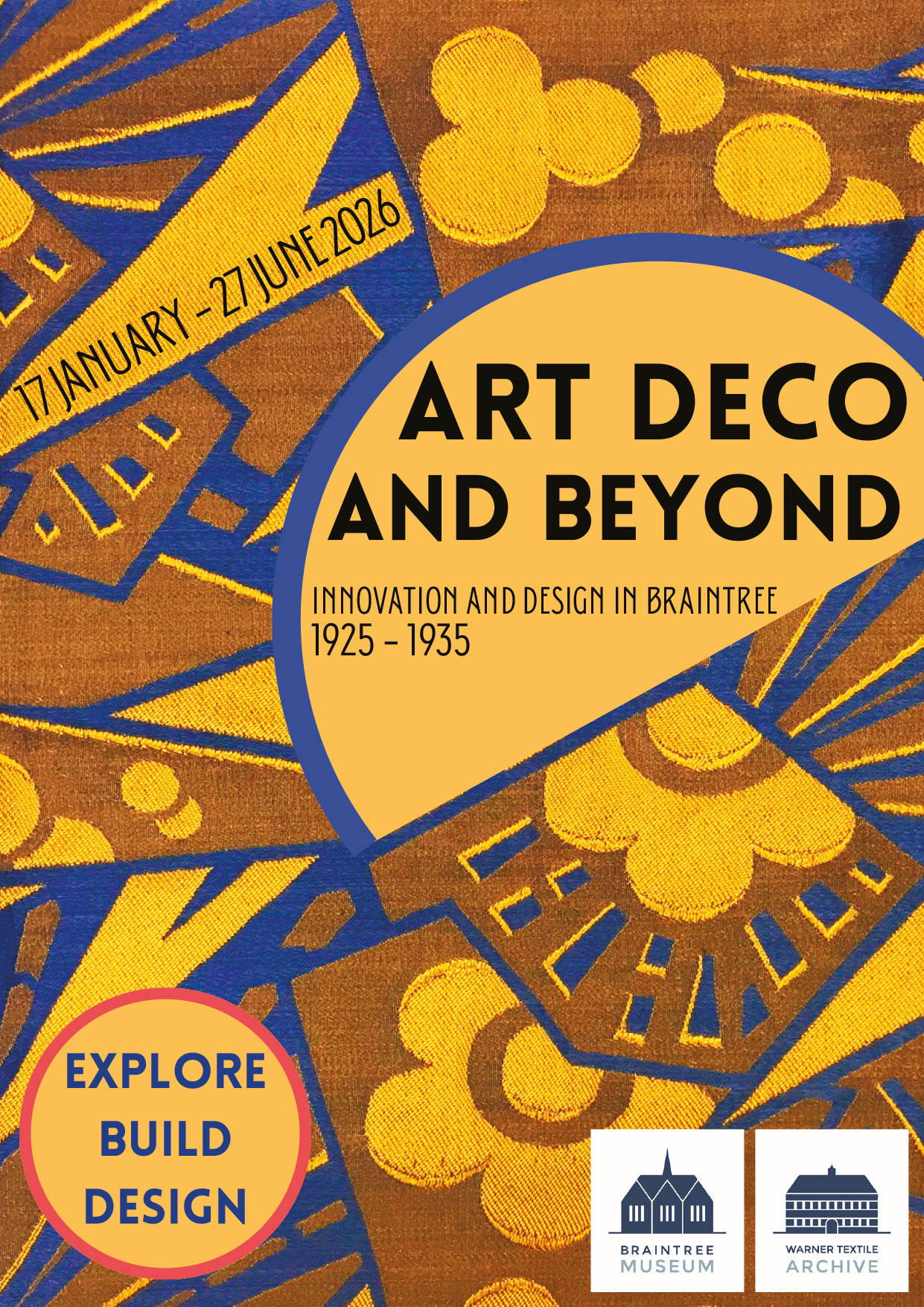
Innovation and Design in Braintree 1925-1935 in collaboration with the Warner Textile Archive
17th January 2026 – 27th June 2026
Now open at Braintree Museum, Art Deco & Beyond showcases the opulence and glitter of Art Deco textiles as you would expect, but also highlights the bold hand-block printing that developed with figures such as Enid Marx, Phyllis Barron and Joyce Clissold. The exhibition also explores the steadfast continuity of traditional silks and printed textiles that continued to have their place in interior decorating. There is a spotlight on some of the key industrial developments of the time, in particular with the construction of the pioneering Art Deco Crittalls Silver End village within the Braintree District. There’s an in depth look at the developments of synthetic fibres, specifically the innovations in Rayon by Courtaulds who were based in Braintree, the impact of which filtered down to Warner & Sons.
At first glance the exhibition offers us a window into the homes, workshops, factories of the 1920s, and those key companies; Warner & Sons, Crittalls, and Courtaulds – all based in Braintree – who were leaders in the world of design and industry. But this exhibition offers much more than historical facts – it aims to inspire, to make audiences marvel at the audacity of people to stretch the parameters of architecture and textile design.
There were two significant trade exhibitions of the time – The British Empire Exhibition at Wembley in London in 1924-1925, and the International Exhibition of Modern Decorative and Industrial Arts, Paris, in 1925. Warner & Sons exhibited at both venues to great success.
Many of the textiles that were displayed for those shows have been brought back together for this exhibition and allow us to build a picture of the persona Warner & Sons were presenting to the public in the 1920s.
While handwoven silk textiles were the cornerstone of Warner & Sons production, the firm also traded in printed textiles. In the 1920s demand for printed designs increased, and the less expensive medium allowed for greater experimentation. This is where we find some of the most daring patterns of the time.
The exhibition is a chance to see textiles which have never been on display before from the Warner Textile Archive, and hopefully will give visitors a clearer picture of just how much experimentation was happening in terms of design and industry in the 1920s and 1930s in Braintree and beyond.
Some highlights from the display:

‘Kenilworth’, handwoven silk and metal three pile velvet, designed in 1915,(W1259).
‘Kenilworth’ was exhibited at the British Empire Exhibition in 1924 as an extravagant example of the expertise of the designers and weavers at Warner & Sons. Three pile velvet was a process of weaving three heights of silk velvet patented by Frank Warner in 1914. The process was labour intensive and required a large quantity of raw material, making the finished piece very expensive and thus primarily used to showcase the technical skill of Warner & Sons rather than a textile expected to be a bestseller.
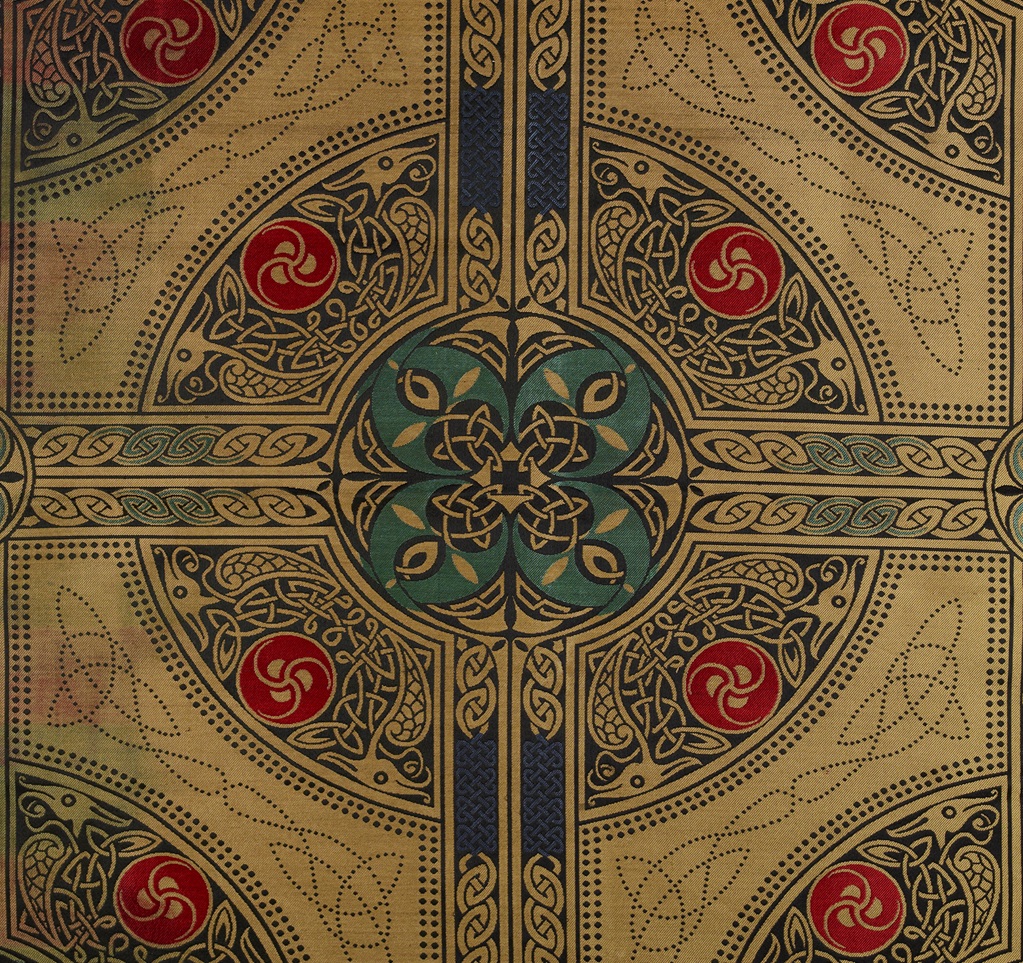
A Celtic pattern called ‘Kelty’ designed by Coombes and woven by Warner & Sons won a silver medal at the International Exhibition of Modern Decorative and Industrial Arts, held in Paris in 1925, as an example of a high standard of design.
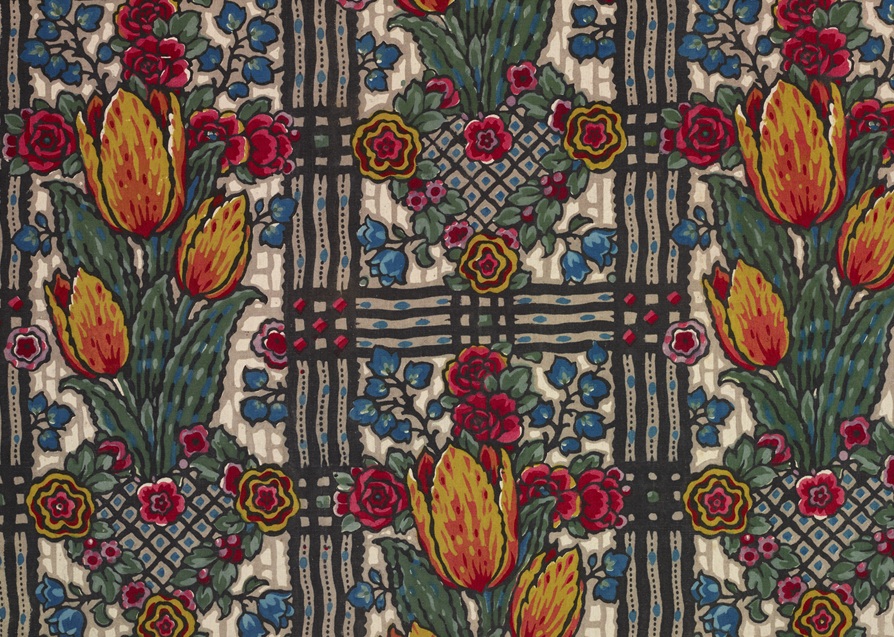
Bright stylised tulips with a heavy black outline and a busy criss-cross background provide a bold Art Deco pattern printed by Warner & Sons.
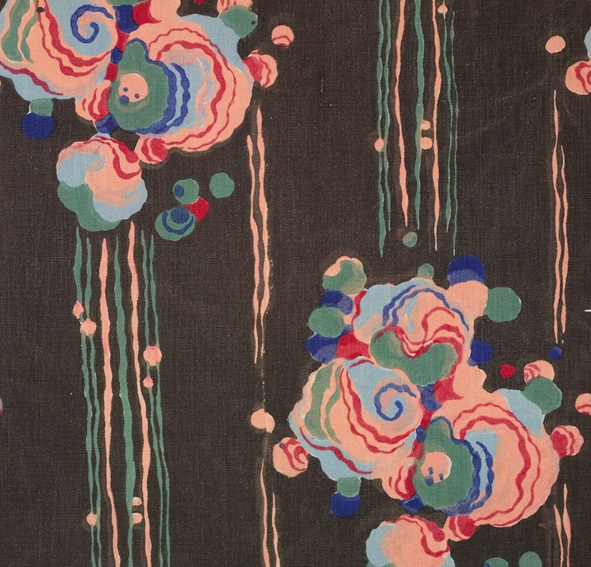
The name suggests this design was influenced by Futurism which was an artistic and social movement originating in Italy in 1909. The movement aimed to capture in art the dynamism and energy of the modern world, embracing speed and technology. ‘Futurist Trail’ appears to have taken influence from these abstract notions while maintaining the timeless appeal of the traditional floral trail motif.