
The Costume Society: Museum Work Experience Grant
We are pleased that our collaborative application for The Museum Work Experience Grant from The Costume Society was successful with Jessica Flewitt. A dedicated volunteer at the Warner Textile Archive, this extended placement is allowing us to offer Jess valuable training in specialist costume conservation and collection management to enable her to pursue her career in textile conservation.
The Warner Textile Archive is benefitting already through improved documentation, enhanced storage and accessibility of collections, as well as a broader understanding of some of the specific conservation challenges of the collection. We are excited to see what else we discover through this project.
Jess will showcase a selection of the Chinese costume collection to our visitors joining us for London Textile Month hosted by Selvedge and will be a focus for around 50 visitors to the Warner Textile Archive for Heritage Open Days. It will be wonderful to share the work that Jess has accomplished with a new audience and display objects the public have never seen before from the collection, made accessible through this project.
Project Overview by Jessica Flewitt
As we reach the mid-way point of the project, it is helpful to reflect on what has already been completed and what was discovered. Throughout the project I have had the privilege to work with some amazing costumes and textiles and examine them up-close.
I started by going through the list of costume or dress related items we have in the collection to determine what should be investigated. The main priority was to locate and catalogue the costume related items in the document collection. When referring to documents in the archive, this refers to objects that were collected for inspiration for the designs, not paper documents. This was broken down into French trimmings, Chinese costume and accessories, Indian costume and accessories, and other miscellaneous. Most items were located in a section of drawers, with unrelated textiles and other items scattered in boxes or storage across the archive.
I began with the section of eleven drawers which contained the bulk of the dress collection. Firstly, I needed to separate the costume related objects from the unrelated objects that were to be returned to their rightful locations in the archive. I retrieved the related index cards, searched collections index+ or researched the items to make sure they belonged in the costume collection. A lot of flat textiles were samples or pieces of fabric used to make dresses, ties, shoes or accessories, some made by Warner & Sons and some sourced from elsewhere, these are important in their own right but didn’t necessarily belong with the costume objects so had to be catalogued and relocated elsewhere. This then left me with the focus of the project, the costume document collection.
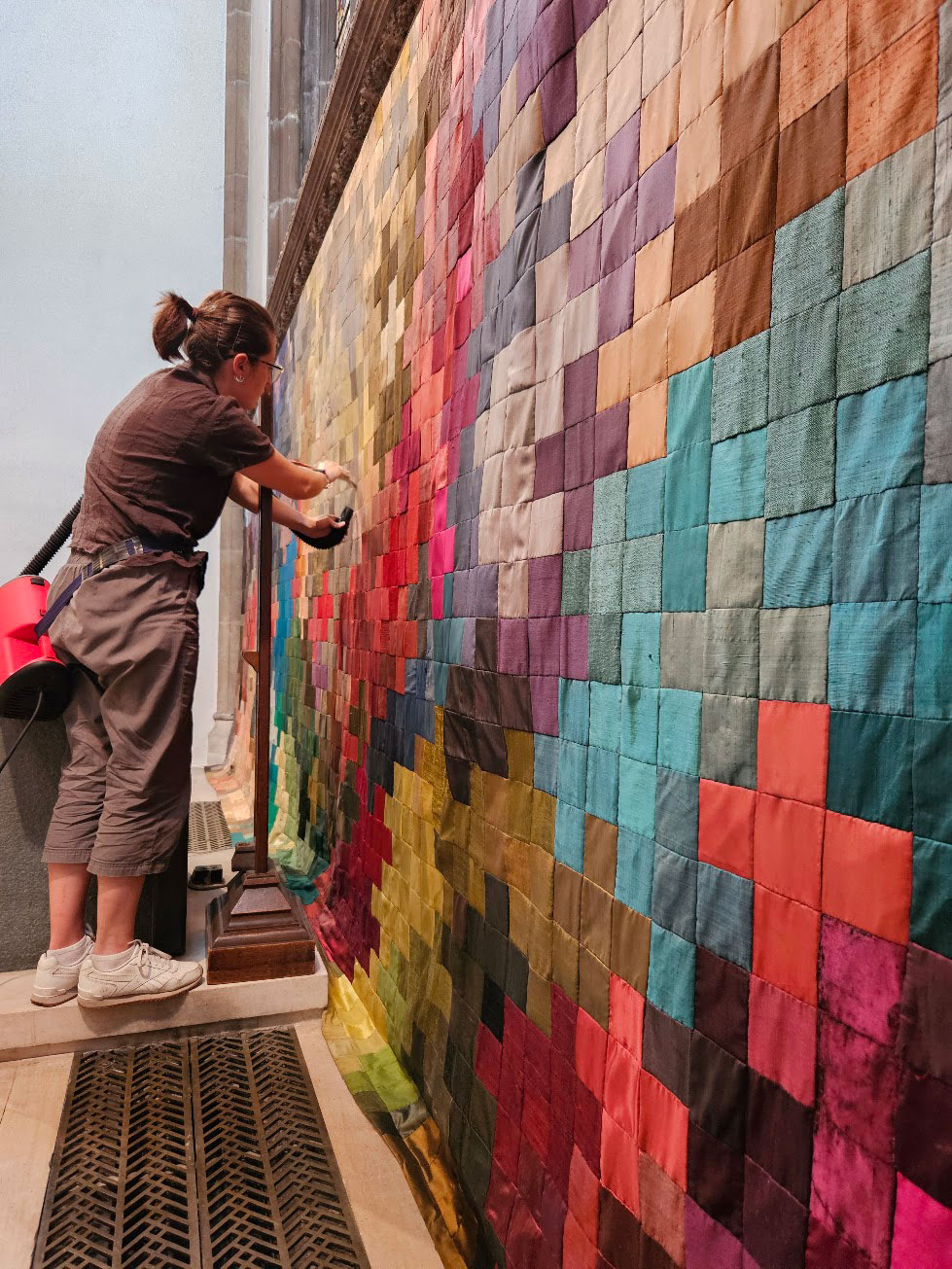
Jess vacuuming the Beryl Dean patchwork wall hanging at Chelmsford Cathedral
To keep a record of the process and keep organised while completing this project I created an Excel spreadsheet, this contained a tab for:
1.The list of any costume and dress related items on record.
- My findings and investigation on each item showing the updating of index cards, online index and labels.
- The updated locations and research I found added or updated to the description on collections index+.
- Links to research sources or museums for some items.
- Condition list for items which need to be monitored or reviewed for conservation treatment.
For my own personal notes, I recorded interesting textile processes and techniques, previous conservation work and possible conservation treatments that could be used, decisions on mounting techniques and reasons for storage decisions.
I began with the French trimmings. The dress collection at the archive contains various pieces of historical passementerie, which are handmade trimmings used on furniture, interior or clothing. The pieces at the archive mostly use jet or black bead embroidery, or soutache and rouleaux braiding.
Firstly, I needed to assess what was present and locate all the pieces with any pairs. The pieces needed to be mounted onto Calico fabric to give support as some pieces are fragile. I used natural thread to mount the delicate pieces and attach new labels to the mounts. While mounting I also checked the measurements, accession numbers, descriptions, and the condition of the pieces. It is important to make sure information is up to date for the collections management system. Before updating the archival records, detailed photographs needed to be taken of each piece for identification and condition analysis.
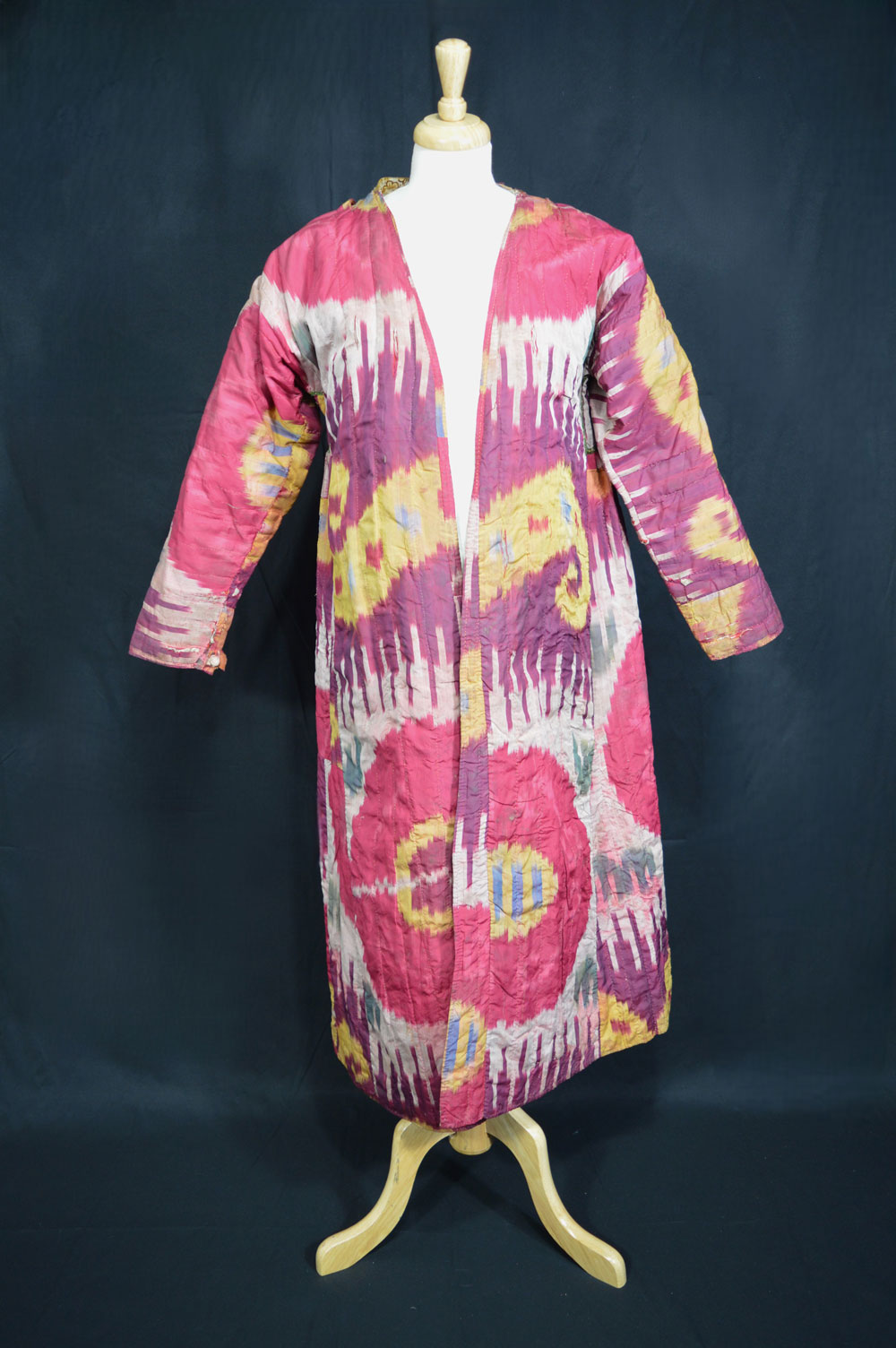
Ikat jacket from Turkestan/Usbek c.1860-1900
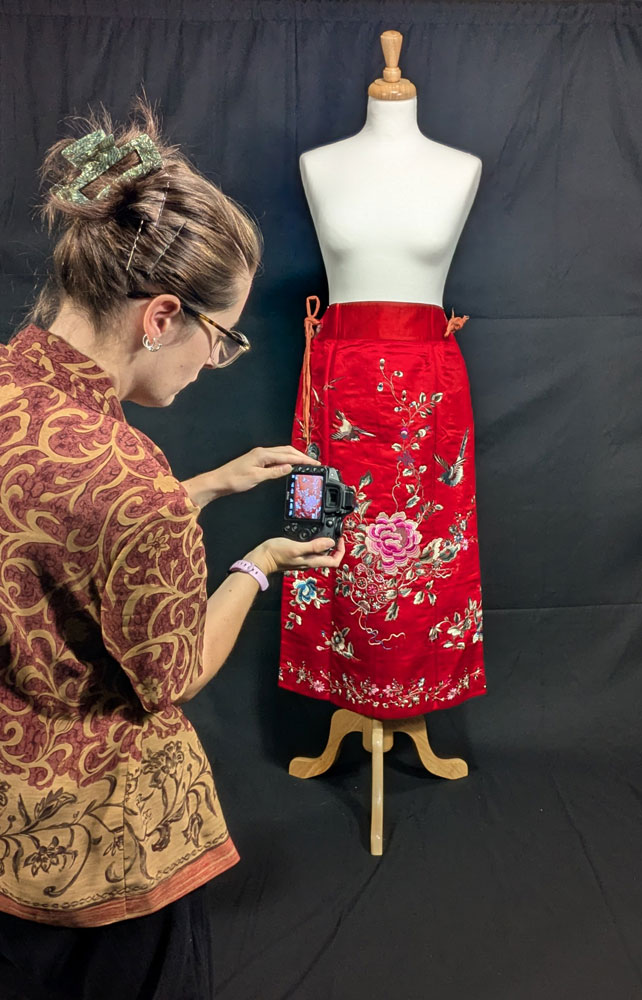
Jess photographs a Chinese wedding skirt
There is little known about the provenance of the passementerie pieces, but after researching I believe most of them to be Victorian dress trimmings. I came to this by examining the techniques and materials used, as well the shape for intended use while comparing with historical examples and research references. The applique pieces would have been sewn onto capes and dresses to decorate and show wealth. Research shows that the skills may have been developed in Spitalfields, passed down by French and Dutch Huguenots.
I then went on to the shawls and handkerchiefs. Upon inspection some of the shawls were in bad condition due to their age and material. Most used natural or delicate fabric like wool which had previous pest damage. I documented the bad condition pieces by taking photos of the area of concern, then updated collections index+ with the condition findings. Sometimes items have provenance attached to the index card which is very helpful. One handkerchief had a letter from the maker explaining the process of how she made it.
Next the international textiles collection. The international textiles collection was a collection of mainly Chinese objects as well as Indian, Japanese, and African. Most of the items were bought at auction houses, through textile collectors or brought on travels. The items were spread across the drawers, so I arranged them into groups to keep the drawers themed.
Overview of international textiles surveyed as part of the project:
Chinese costume – of mainly red Chinese embroidered wedding skirts, embroidered collar, child’s embroidered jacket
Indian costume – of mainly saris, a child’s hat and jacket, head turban wrap
Asian documents – of other Asian items, Japanese print, Chinese wedding valances, Chinese embroidery panels, imperial Chinese book scroll cover, etc
Some of the costume pieces in the drawers were large or bulky, and at risk of being damaged or were taking up too much room. So, these needed to be rehomed in boxes on shelves. These included a blue Manchu Chinese silk and metal embroidered jacket, a Chinese Han dress robe, Japanese trousers, a Turkestan Ikat coat, a 1970s quilted jacket and African Muslim prayer caps.
One of the pieces I encountered was dissociated from its index card and was a bizarre cloth rope in tie dye. I suspected it to be Indian tie dye but was baffled by the technique of knotted balls. Once I had searched through the lists of index cards I found one labelled Indian turban. I researched Indian turbans and dying techniques and found it to be an Indian turban cloth using a dying technique called Lehariya, the piece we have is still partly tied in the knots for this technique which was fascinating. It is wonderful to learn about new textile techniques from around the world. The Turkestan/Uzbek Ikat Chapan coat was another fascinating technique to learn about. The coat is in bad condition due to the deterioration of silk threads and surface staining but for me this was interesting to see from a conservation aspect.
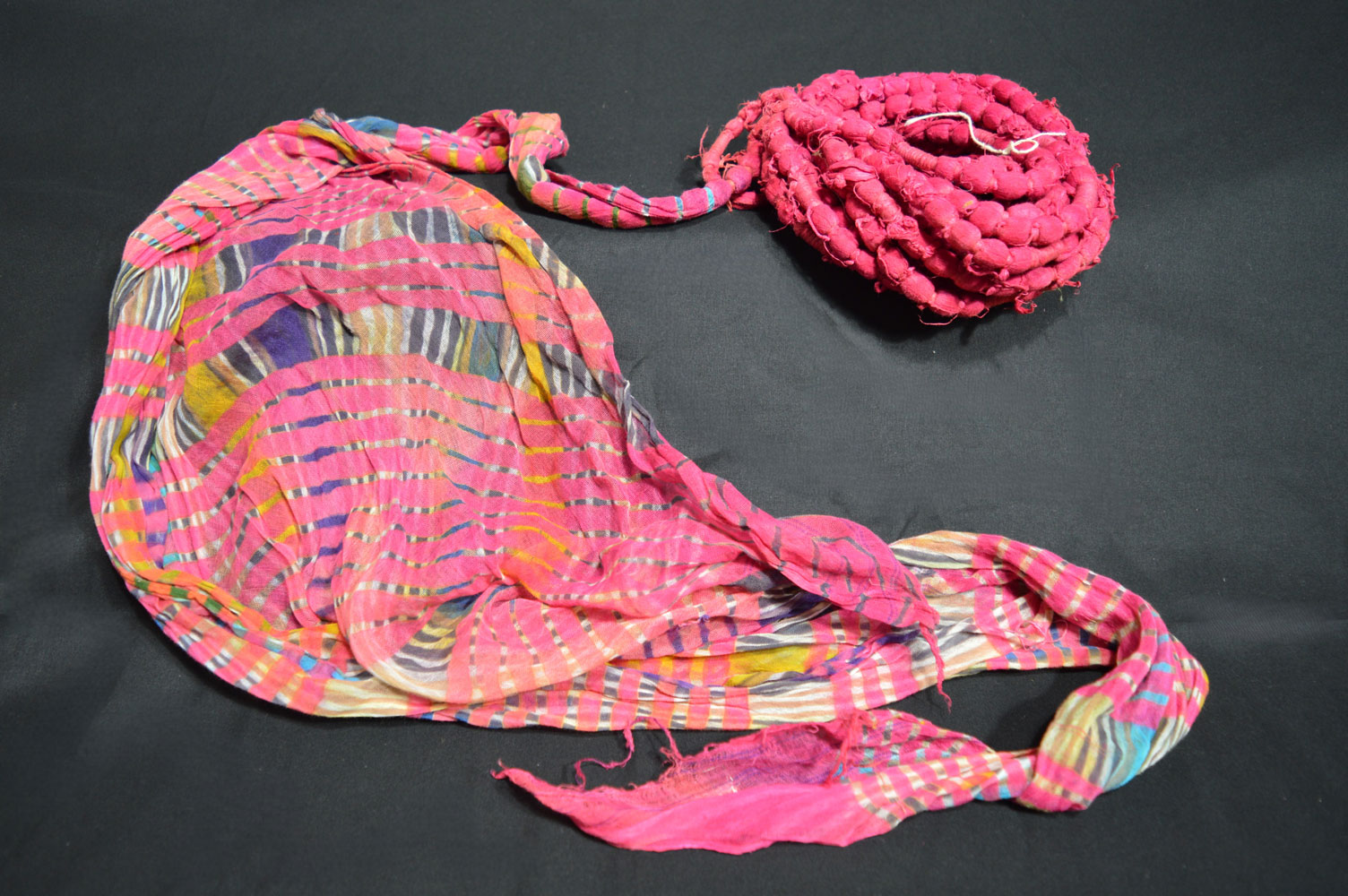
Indian turban cloth using a dying technique called Lehariya
I also had the opportunity to use the photography backdrop and lights with the mannequin to take photos of a selection of the garments. I used polyester wadding to pad out the mannequin where needed. I also had the opportunity to assist with in-situ conservation vacuuming a patchwork tapestry at Chelmsford Cathedral. It was a good experience to be able to work on location and assist with cleaning the 2,200 silk squares, as well as discussing the condition report and any conservation proposals.
I am currently working on a variety of pieces, including items with missing information or objects that are scattered in different locations in the archive. The next phase will be to investigate the skirt made for Queen Mary in c.1893 and other standalone objects before then looking in depth at individual conservation treatments.