
Intersecting Family History with an Archive
Isobel Abbott-Dethrow, University of Essex
My pursuit of a master’s degree in art history and theory at the University of Essex was a long time coming, generationally. A mission to honour family history was embedded within my academic journey, starting in the United States and tracing my family’s footsteps back to my grandmother’s village, Great Bardfield. During my undergraduate and postgraduate years in the St. Louis region, I came to know the significance of my great-grandparents’ involvement with the Great Bardfield Artists movement, as my great-grandfather, Bill Slow, was an apprentice of Edward Bawden’s and took his weekend watercolour courses at Bawden’s home that he once shared with Eric Ravilious. My great-grandmother, Kathy Slow, was John Aldridge’s housekeeper for several decades and knew the ins and outs of Place House, which she withheld from public knowledge to her passing at the age of 102.
When I chose the Warner Textile Archive for my practice-based output as part of my Archives and Power course, it felt as if the assignment, to create authority records about Edward Bawden and John Aldridge, fell right into my lap. The name “Marianne Straub” was first mentioned regarding finding information about two artists involved with the Helios design group, and I mentioned my acquaintance with her because of my dissertation topic, which is about the relevance of place within the Great Bardfield Artists movement. While I already felt that the requirement for the Warner Textile Archive’s output aligned with what experience I was seeking out, I certainly did not expect this. The research I would then begin to conduct for the Warner Textile Archive would also benefit the preparation of my dissertation.
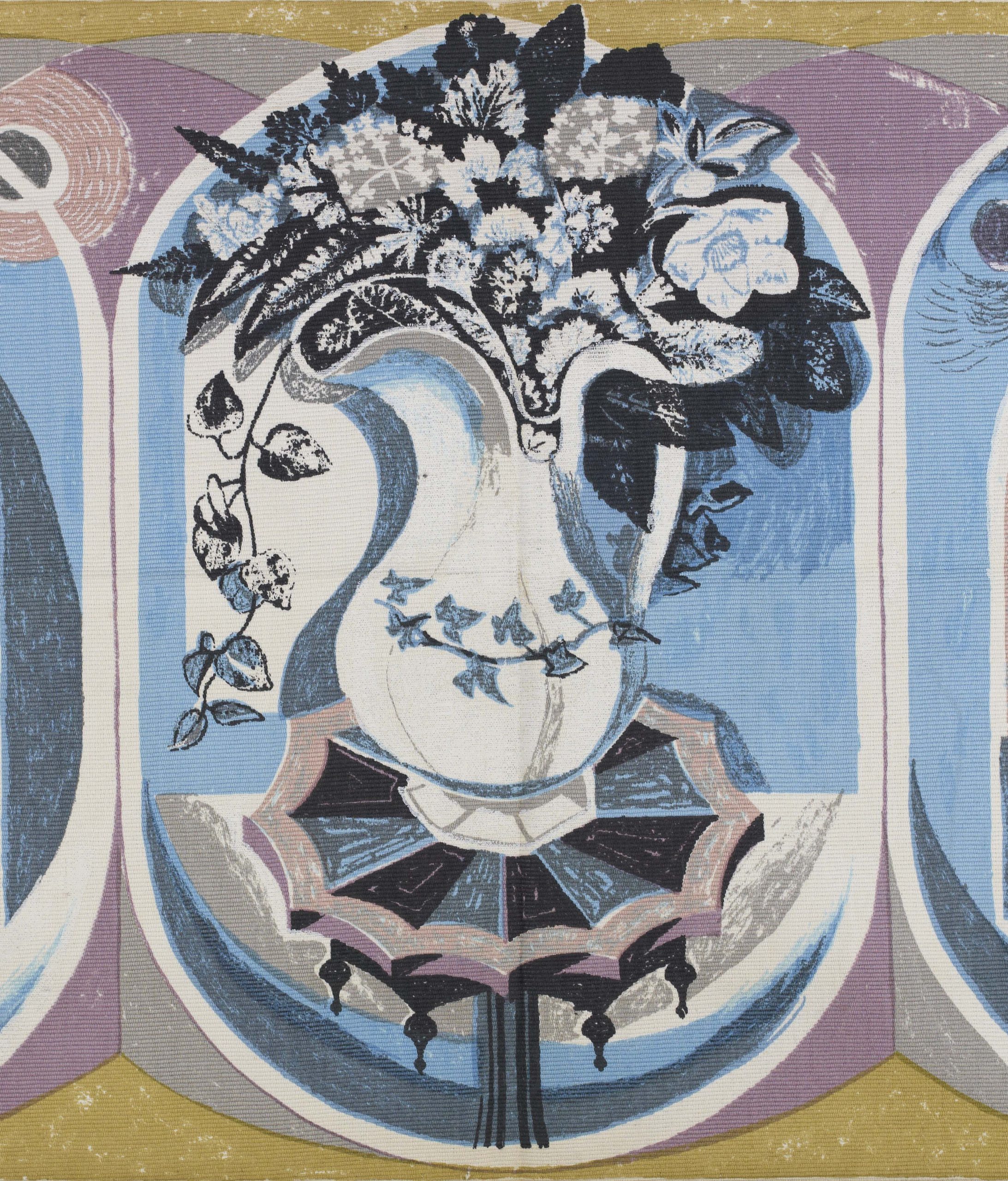
CR319a ‘Night and Day’, section of a printed cotton by Edward Bawden for Warner & Sons, 1957.
Going into the task of compiling information for Bawden and Aldridge’s authority records, I was already familiar with both artists’ mediums of watercolour and oil painting, respectively, along with Bawden’s graphic designs and linocuts. I was vaguely familiar with Bawden’s experience in wallpaper design before beginning my research. There is an overabundance of commissions and illustrations that Bawden produced in his lifetime, which is what I found while doing my reading and compiling of information for the records; among the overwhelm of how many artworks Bawden created, I had to carefully choose which moments to include and prioritize for the archive’s record, to make sure they aligned with the history of Warner & Sons. Research for Aldridge’s authority record was less complicated in deciding what parts to include or omit, as he only had one major diversion from painting in his career, which he created with Bawden, the Bardfield Wallpapers. The decision making of choosing which information to include in Bawden’s authority record for the Warner Textile Archive had reminded me of a lecture I had during my Archives and Power course where the issues surrounding the Stasi files of Eastern Germany were discussed, as their archives were overloaded with information about various individuals the police surveilled over the years, containing details and records that created more clutter, rather than necessary knowledge about people of interest. Through the large amount of literature and information out there about Bawden’s work, I was able to keep his authority record relevant to discussing his ventures in wallpaper and textile design.
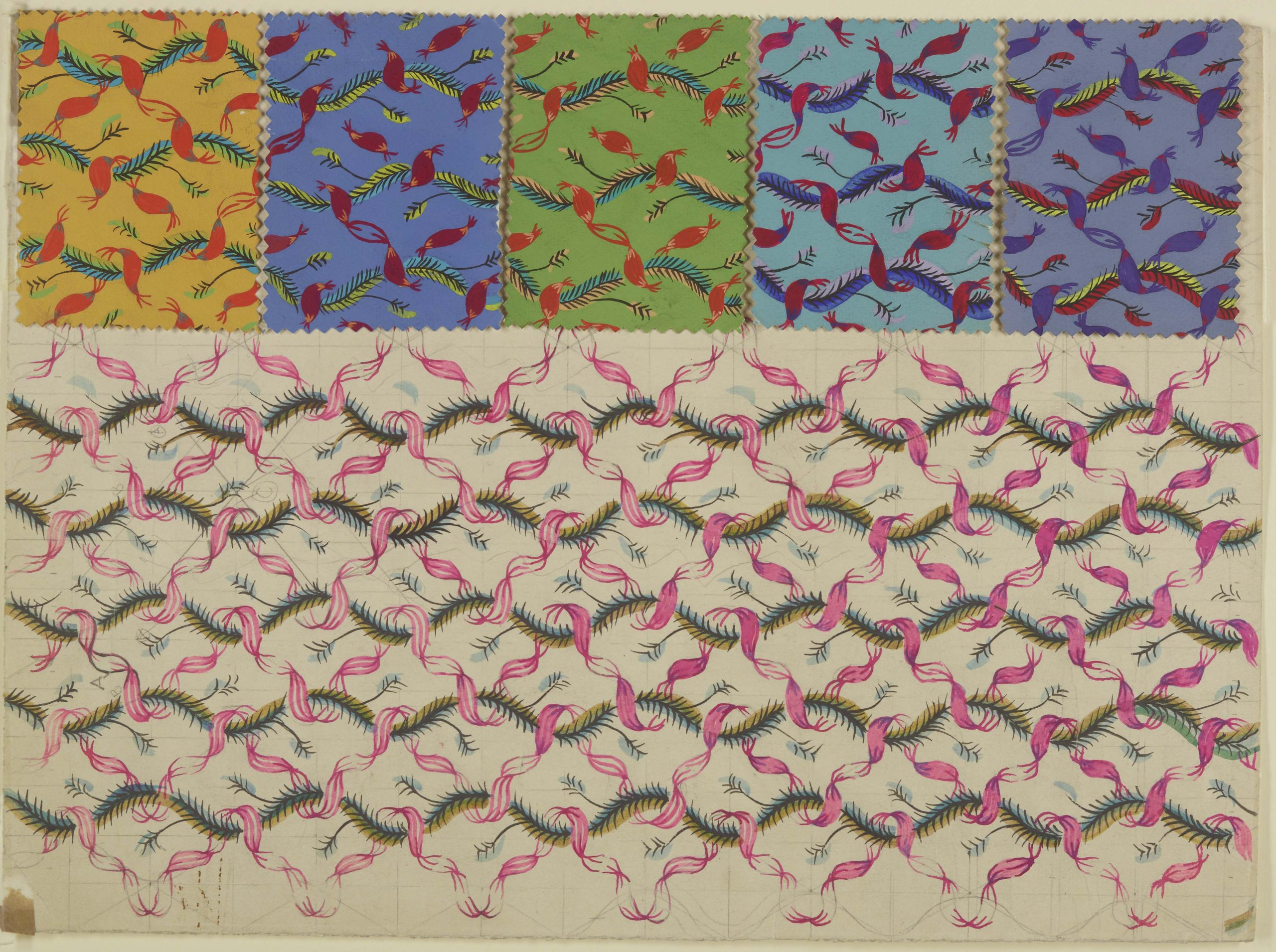
3764 ‘Ribbon’, hand-painted design by John Aldridge, c.1940-1941, part of the Helios collection at the Warner Textile Archive.
I especially loved finding out information about the Bardfield Wallpapers and how both Bawden and Aldridge collaborated on this enterprise together, especially with the intersection of my own family history, as my great-grandparents had formed relationships with these artists. Before doing my research for Bawden and Aldridge’s biographies, I only knew of Aldridge’s favoured medium of oil painting and was not aware of his diversion into wallpaper design, especially how this culminated into a collaborative effort with Bawden. I also was fascinated by the fact that Aldridge was entirely self-taught and did not have any academic art background, honing his craft while he studied Classic Literature at Oxford University, then diving into the Seven and Five art society in metropolitan London’s art scene after his graduation from Oxford. As a fellow self-taught portrait and landscape artist (in watercolour and acrylic) who studied English Literature in my undergraduate years, it was fun noticing parallels. Through his connections to the Seven and Five society and friends such as Cedric Morris, this catapulted Aldridge into a non-conventional path of being a full-time artist; his beginnings were different from Bawden’s, who went the academic route of studying at the Royal College of Art, yet Aldridge still found a way to become an art professor, which is a feat that would be extremely difficult nowadays.
Along with discovering newfound information to myself about Bawden and Aldridge for the Warner Textile Archive’s authority records, and inadvertently my own postgraduate dissertation, I was also given the opportunity to have hands-on experience with other conservation practices, such as cataloguing, preparing an artwork to go on loan, uploading high resolution images to an archival platform, and providing in-depth descriptions about particular textiles. For cataloguing, I went through a prepared box full of paper designs of artwork that showed the colours and outlines of designs before they went through the manufacturing process; the oldest design layout I held was from 1884 and the paper was incredibly fragile, but most of the designs were from the late 1920s and of varying condition. I got to use a conservation-purpose vacuum to prepare a textile piece that was about to go on loan and learned how to delicately clean the artwork, using soft bristled brushes and a filtered nozzle, which became a meditative process over time. For me, the most fun and time-consuming part of the archival process was writing descriptions about artworks. The Archivist, Sophie Jemma, had gotten out various wallpaper designs and prints that were related to my authority records, which included designs by people involved with Helios. One piece I wrote about was a ribbon design by John Aldridge, which was quite difficult to summarise because it was a case of multiple colour swatches. With artwork, you must spend an intimate amount of time looking at a piece to fully understand and analyse the artist’s style, so I spent a lot of time alone picking apart the colour choices and fading ink lines.
All in all, I feel privileged to have had these opportunities with the Warner Textile Archive through my Archives and Power class. The chance to write about Edward Bawden and John Aldridge for them still rings as uncanny to me, and that will stick with me for the rest of my life.