
From Christie’s to Warner & Sons: Uncovering the Story of Lot 22
Abbey Swan, University of Essex
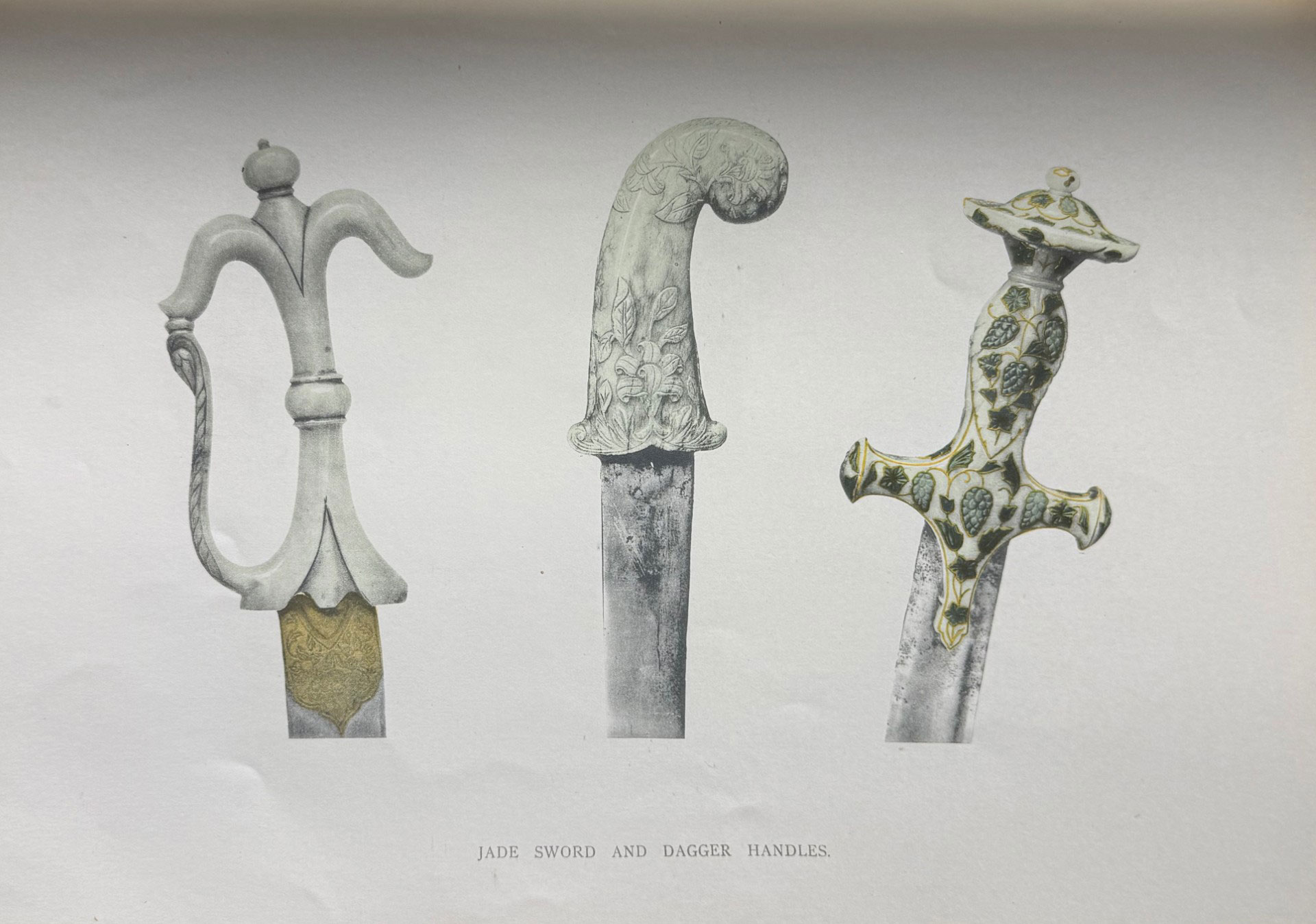
Figure 1 (WB/1/3/15/4) An illustrated print of ‘Jade Sword and Dagger Handles,’ by W. Griggs, featured in Issue 20 of the Journal of Indian Art, accompanying John Lockwood Kipling’s article ‘The Industries of the Punjab.’
Earlier this year, at the end of May, I began a nine-week placement with the Warner Textile Archive, where I physically reorganised and digitally catalogued part of their Library and Reference Collection. The collection holds roughly 1,500 to 2,000 publications, periodicals, and theses that had arrived in Braintree in 2004, along with the rest of the archive, but had not yet received the attention needed to make it fully accessible to staff, researchers, and volunteers.
The Library and Reference Collection was an invaluable resource for Warner & Sons designers, inspiring paper designs and, later, helping archivists understand different design movements and periods. Most of the publications I encountered bore either a “Print Studio” or “Design Studio” stamp, each featuring one of two London addresses where Warner & Sons’ Print and Design Studios operated until the early 1990s. Later, a third stamp appeared, matching the earlier format but showing a new Milton Keynes address, marking Warner & Sons’ relocation to Milton Keynes after its acquisition by Walker Greenbank PLC. Information on who purchased the books is limited; however, clues can be found within the publications themselves – such as notations from staff members, most notably Chief Designer and later Director Eddie Squires (1940-1995), who often scrawled “E.S.” in the stamp’s blank space, sometimes accompanied by anecdotes about where or when the book was acquired. Further annotations and scrap pieces of paper appeared throughout the collection, marking individual illustrations on pages that could prove useful for a design, or whole pages that featured Warner & Sons advertisements or mentions.
Notably, during my placement, we were able to ascertain how the books made their way from the Print and Design Studios in London to the archive in Braintree: once the books had reached the end of their useful life, or when designers needed to free up space for new publications, they would be packed up and sent to Braintree, where an Archivist catalogued them on paper index cards before entering them into the collection.
While working with the collection, I came across several notable books, but none left as strong an impression as The Journal of Indian Art, Vol. 2, Nos. 17-24, illustrated and published by William Griggs (1832-1911) in 1888. At first glance, The Journal of Indian Art, with its black leather binding, gold-lettered spine, and mottled, timeworn cover, presented a humble façade that offered no clue to the remarkable contents within. Once I learned its age, I placed the book on a book-display pillow to take the pressure off its spine and began gently turning through its pages, discovering impeccable print after impeccable print of Indian pottery, textiles, armoury, architecture, and more. I was in awe of how vibrant the colours were so many years later, and how incredible the prints were, with meticulous detail that, at first, I did not understand could exist from so long ago. They looked like coloured photographs, yet somehow tangible at the same time. Through my research, I discovered that most of the prints that captivated me were created using a groundbreaking process developed by William Griggs of photo-chromolithography. This technique allowed Griggs to seamlessly integrate photography, science, and art to produce stunningly detailed, vibrant coloured images of architecture and objects. The process began with a photographic negative and a detailed record of the original objects or buildings’ colours, which Griggs then used to faithfully reproduce the subject through successive printing layers using Bavarian stone or metal plates, building the photograph into a coloured print.
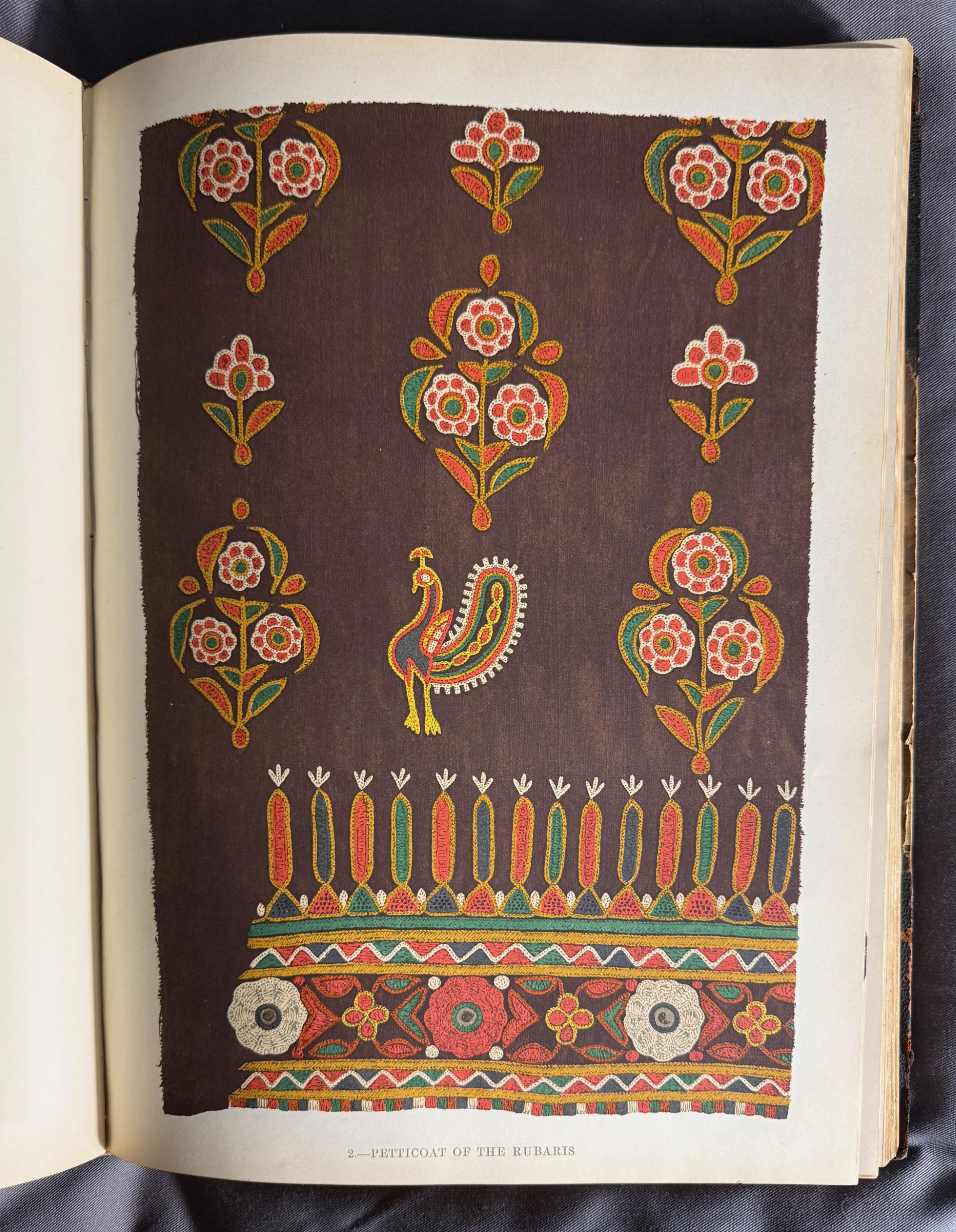
Figure 2 (WB/1/3/15/4) An illustrated print of the ‘Petticoat of the Rubis,’ by W. Griggs, featured in Issue 18 of the Journal of Indian Art, accompanying B. A. Gupie’s article ‘Embroidery.’
At the front of The Journal of Indian Art, I found a Print Studio stamp that read “Print Studio, Warner & Sons Ltd., Noel Street, London, W1V 4AL, Tel: 01-439-2411,” and was dated 1979. Beneath the stamp, in handwriting likely attributed to Eddie Squires, was the note “Bought from Christies.” When I examined the volume more closely, I discovered a Christie’s Lot No. ticket marked “Lot No. 22, 14 Nov 1978,” tucked between pages 18 and 19 in Journal 19, an unexpected find that provided a direct link to its auction history. This discovery prompted me to search through a pile of Christie’s auction catalogues that had caught my eye when I began assisting with the physical reorganisation of the Library and Reference Collection. Among them, I found the very catalogue from that November day: “Sale of Reference Books on Textiles; Textiles and Costume, on Tuesday, November 14, 1978, at 2.00 p.m.” In the upper right corner, three names were written in pen: “E. Squires, F. Davies, and H. Bury,” likely Eddie Squires, Frank Davies and Hester Bury, suggesting the trio spent the day at the Christie’s auction. Tucked inside the catalogue was an index card for a design (now crossed out), with a list on the reverse that began with “Books bought from Christie’s 14.8.78,” recording four lots acquired that afternoon. Alongside the Journal, the group also acquired three books on textiles, a Chinese embroidered collar, robe, pair of trousers, headdress, and a sleeve, as well as seven books on design and batik. In total, they spent £92, including £22 on The Journal of Indian Art (equivalent to £125.46 in September 2026). This was a considerable sum for the 1970s.
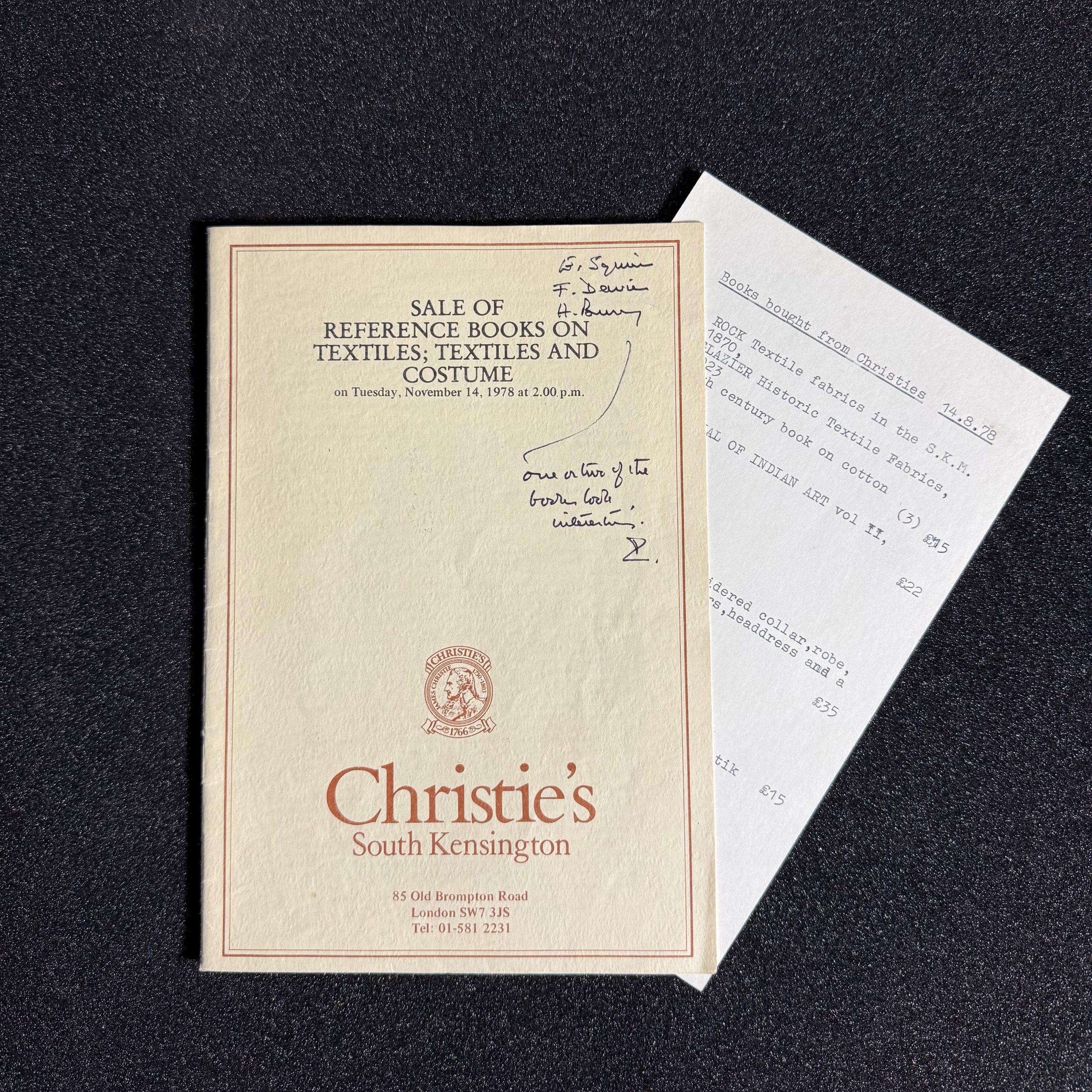
Figure 3 Christie’s auction catalogue for the sale of Reference Books on Textiles; Textiles and Costume, held on 14 November 1978, bearing the handwritten names E. Squires, F. Davies and H. Bury. Accompanied by a typed index card titled ‘Books bought from Christies 14.8.78,’ listing the lots purchased and their prices.
I imagine Squires, Davies, and Bury were drawn to The Journal of Indian Art for the same reasons I am; its extraordinary photographs and prints of Indian textiles, architecture, and design. The vivid colours, intricate details, and enduring beauty on every page would have been a treasure trove for designers in the late 1970s, just as they remain for researchers and enthusiasts today. What makes this book particularly noteworthy is that it’s the only one during my placement whose provenance I was able to firmly establish. Tracing its journey back to Christie’s and identifying those who brought it into the collection was especially rewarding, and I have enjoyed sharing this remarkable volume with fellow volunteers and staff at the Warner Textile Archive.