
Reconstructing Lives History Tried to Erase: Otti Berger and Felix Löwenstein
Abbey Swan, University of Essex
In the first year of my undergraduate degree in Art History, I was introduced to the University of Essex’s Special Collections and was immediately taken by the notion of an archive. I could not believe there was a whole career dedicated to caring for records, preserving them, and making them accessible to others. As I continued my studies, it quickly became clear that my academic passion was rooted in research. I eagerly sought out primary sources, exploring online archives and visiting the Tate Archive for my dissertation on Agnes Martin. Therefore, when I undertook my master’s, I wanted to choose a discipline that would enable me to engage more directly with archives and archival theory, which led me to choose Heritage and Museum Studies, with one of my modules being Archives and Power.
I approached this module somewhat naively, viewing archives primarily as resources to be exploited for research, without considering their broader significance. However, Archives and Power fundamentally shifted my perspective. It exposed the many imbalances and power dynamics involved in deciding what gets preserved, be it documents, physical objects, or spoken word, and what is consigned to obscurity. This reminded me of an earlier module, where historians painstakingly sifted through court records to find even the faintest traces of women’s contributions to the history of work. Archives and Power highlighted that this erasure is not limited to women; any group outside the dominant power structure can be omitted from the historical record simply because those responsible for preservation deemed their stories unimportant. So, when it came time to choose between an essay and a practice-based output for our final assignment, I decided to work directly with an archive and conduct research for them.
Among the available project briefs, Warner Textile Archive stood out to me, particularly because it offered the chance to contribute to their Authority Records (mini biographies) of designers associated with Helios, a brand acquired by Warner & Sons in 1950. While I was initially unfamiliar with Helios and the list of designers in the brief, after looking up figures such as Marianne Straub, Graham Sutherland, and Dora Batty online, I quickly became curious about the project’s wider scope. After meeting with Sophie Jemma, who oversaw the project, and being introduced to the two designers I would be researching, I felt confident that I had made the right decision in pursuing this hands-on archival project.
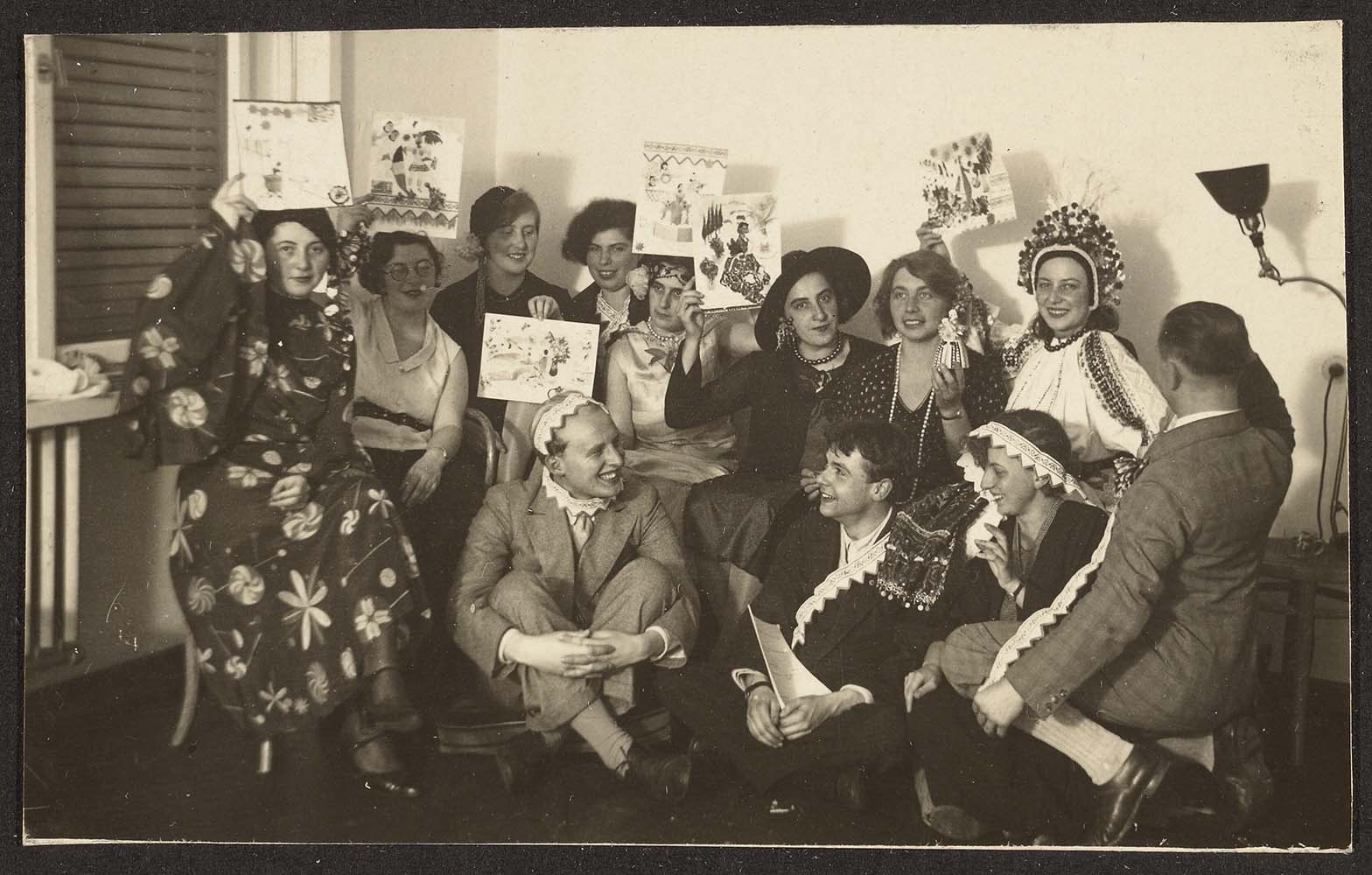
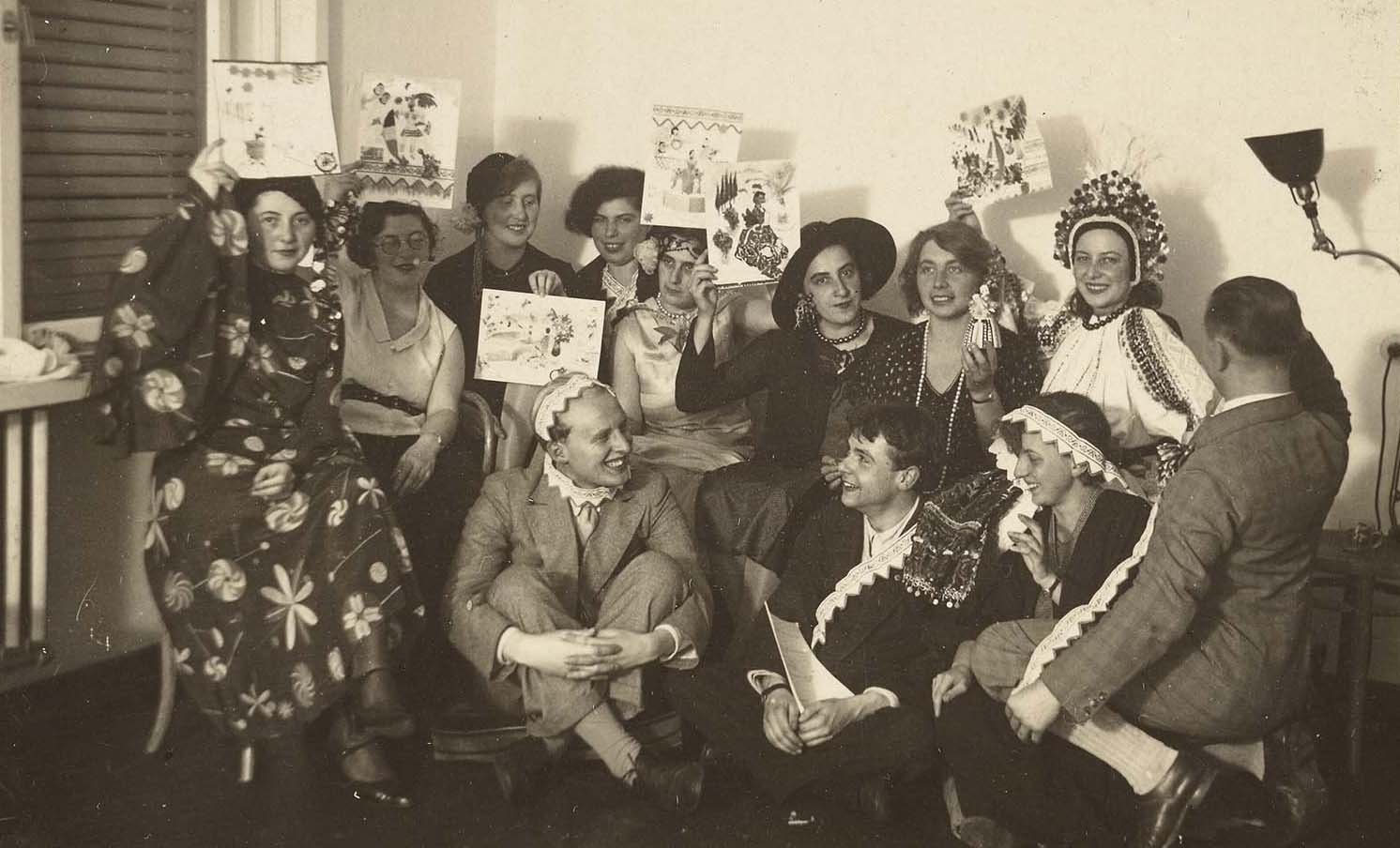
‘Party at Otti Berger’s for first diploma students’, 1930, courtesy The J. Paul Getty Museum, Los Angeles. Otti Berger pictured back row on far right in head dress.
The two designers I was assigned, Otti Berger and Felix Löwenstein, had markedly different connections to Helios: Berger only spent five weeks as a designer, while Löwenstein served as Managing Director. Yet, it quickly became apparent that these two individuals were connected by more than working for Helios. Both had significant ties to the Bauhaus in Germany, and, even more profoundly, they each experienced intense Nazi persecution, Berger paying the ultimate price, with her life being brutally cut short in Auschwitz in 1944/1945.
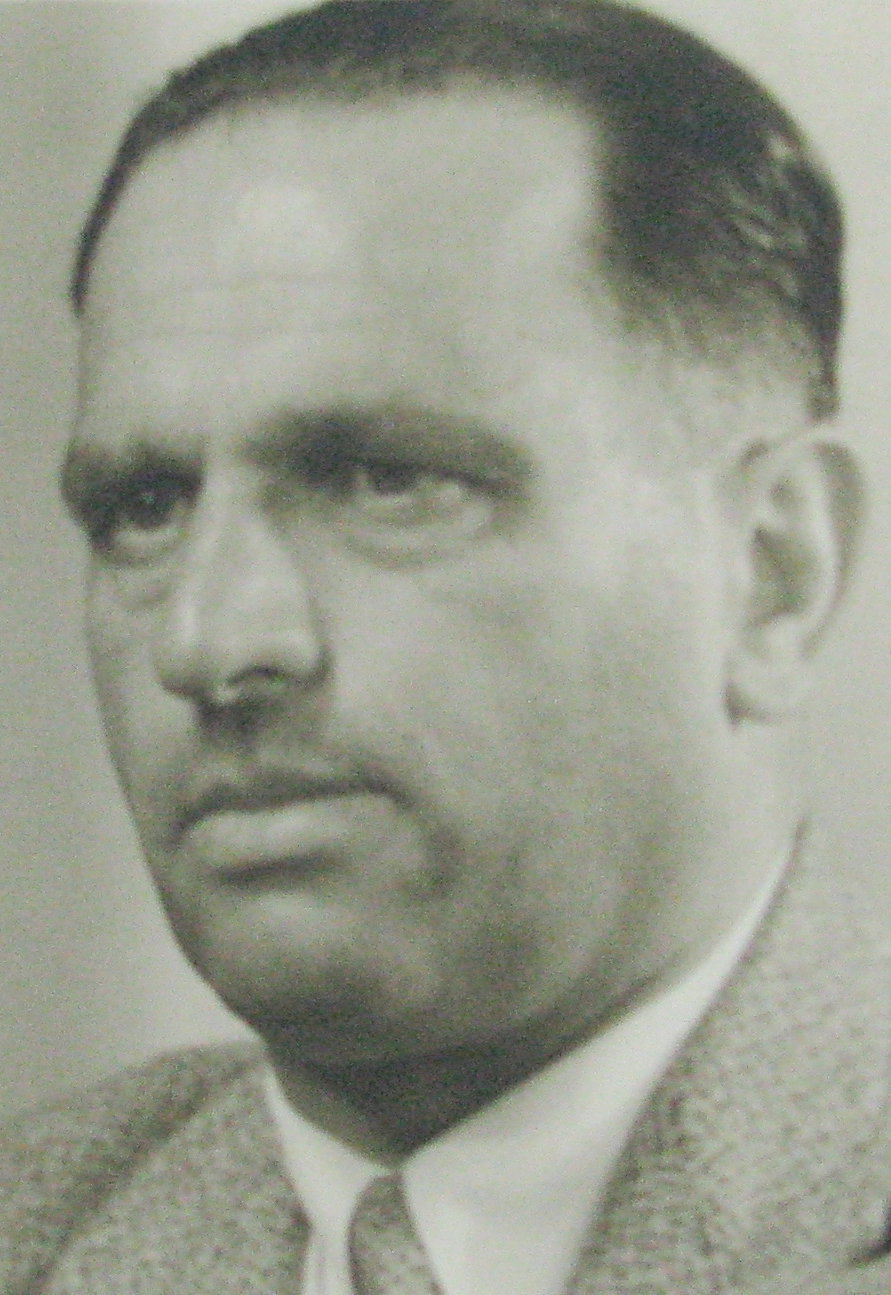
Felix Lowenstein, pictured c.1930s-1940s, courtesy of Welf Schroeter and Irene Scherer at the Löwenstein Research Association, Mössingen
Despite their remarkable lives, both Berger and Löwenstein have received limited scholarly attention. Berger’s legacy has been partially reclaimed thanks to the efforts of Widar Halén, yet she remains less recognised than many of her female Bauhaus contemporaries who survived and shaped their own narratives. Löwenstein’s story was even less documented, prompting me to widen my scope to German-language sources, which I carefully translated to piece together his life. I greatly benefitted from the work of Irene Scherer and Welf Schröter, as well as Löwenstein’s family, who sought to reestablish the family name in Mössingen, where Felix and his brother Artur had founded their first company, Pausa, in 1919.
However, it was whilst I was researching Berger that a particularly poignant moment regarding the fate of her belongings after her death occurred. In Alexandra Matz’s chapter, “Tracing the Threads of a Relationship Through Archival Artefacts: Perspectives on Otti Berger and Ludwig Hilberseimer,” in Formats of (Non)Seeing, 2022, there is a reference to a letter from Ellen Otten, a friend of Berger’s, to Berger’s fiancé, Ludwig Hilberseimer. In it, Otten describes “sorting out the samples, and insofar as possible, putting it into a correct order.” This stood in stark contrast to archival principles I had learned in Archives and Power, where preserving the original order of an individual’s belongings is paramount. Otten’s intervention, though well-intentioned, disrupted how Berger herself might have arranged her possessions before leaving to take care of her mother in Zmajevac. My concern deepened when I realised her estate was prepared for shipment to America at the request of Ise and Walter Gropius, with Hilberseimer’s assistance. Hanna Lindemann, a former employee of the Gropiuses, even drafted a letter on Hilberseimer’s behalf to bolster his legal claim to Berger’s estate, citing English law’s recognition of the fiancé’s rights. Copies of this correspondence are housed at the Ryerson and Burnham Art and Architecture Archive in Chicago, USA, along with the letter from Otten to Hilberseimer. This raised unsettling questions about who has the authority to determine the fate of someone’s legacy when they are no longer present to decide. Berger had twice attempted to emigrate to the United States but was prevented each time. Would she have wanted her archives to reside in a country she never reached? While Gropius and Hilberseimer were close to Berger and had settled in America, her surviving brother, Otto, played little, if any, role in these decisions. Was the transfer of Berger’s estate to the United States a reflection of her wishes or simply a consequence of her connections to Harvard through Gropius, resulting in her archives arriving at the Busch-Reisinger Museum in 1951?
These experiences have led me to a series of central and enduring questions that will continue to inform my approach to archives: How do we remember those who did not live long enough to define their own legacy? How can we be sure that the information that survives reflects their wishes? Who has the right to shape, censor, or amend an estate? When the deceased can no longer exert control over their legacy, who is entitled to decide the fate and stewardship of their life’s work and personal possessions? Each time I encounter an accessioned item or trace its provenance in the future, I will reflect critically on the journey that brought it into the archive’s care, and on the stories that may have been lost, reshaped, or silenced along the way.